
Why data centre migration has become a board-level issue
Data centres are now recognised as essential infrastructure. They support the systems organisations rely on every day, from customer-facing platforms and internal applications to cloud connectivity, financial systems, communications, operational tools and critical data storage.
That is why downtime during a data centre migration is not merely inconvenient. It can affect revenue, operations, customer trust, compliance and reputation. Even a brief disruption can create pressure across the business, especially when services are expected to remain available around the clock.
A data centre migration, then, cannot be treated as a simple transport job. It has to be handled as a business-critical project.
The risk is not simply that a server might be damaged in transit. The greater risk is that an undocumented dependency is missed, a patching sequence is wrong, a cable map is incomplete, a rack position has not been validated, a power-up order is unclear, or a service owner discovers too late that their system depends on equipment that has already been powered down.
These are the issues that can turn a planned migration window into an outage.
Sunspeed’s approach is designed to prevent that.

What a successful data centre migration really involves
A well-run data centre migration starts long before anything is powered down. The most important work happens during planning, where the scope is defined, assets are audited, cabling is mapped, rack layouts are checked, risks are recorded and the migration sequence is agreed.
Sunspeed’s migration process includes pre-migration hardware and cable audits, patching schedules, rack elevations, structured cabling design and detailed migration runbooks. The company also manages de-racking, specialist packing, secure relocation, installation, cable dressing, power-up support and testing handover.
That level of detail is what separates a controlled data centre migration from a high-risk weekend move.
The runbook becomes the backbone of the project. It defines who is doing what, when it happens, what needs to happen first, what cannot happen until another step is complete, and how issues will be escalated.
It also gives stakeholders the visibility they need. IT operations, network teams, application owners, facilities teams, security, suppliers and business leaders can all work from a shared plan rather than assumptions.
For a migration to succeed, physical movement and technical sequencing must work together. Sunspeed’s teams understand both sides of that equation. They are not general movers handling IT equipment; they are experienced data centre engineers, project managers and secure logistics specialists working to a defined technical plan.
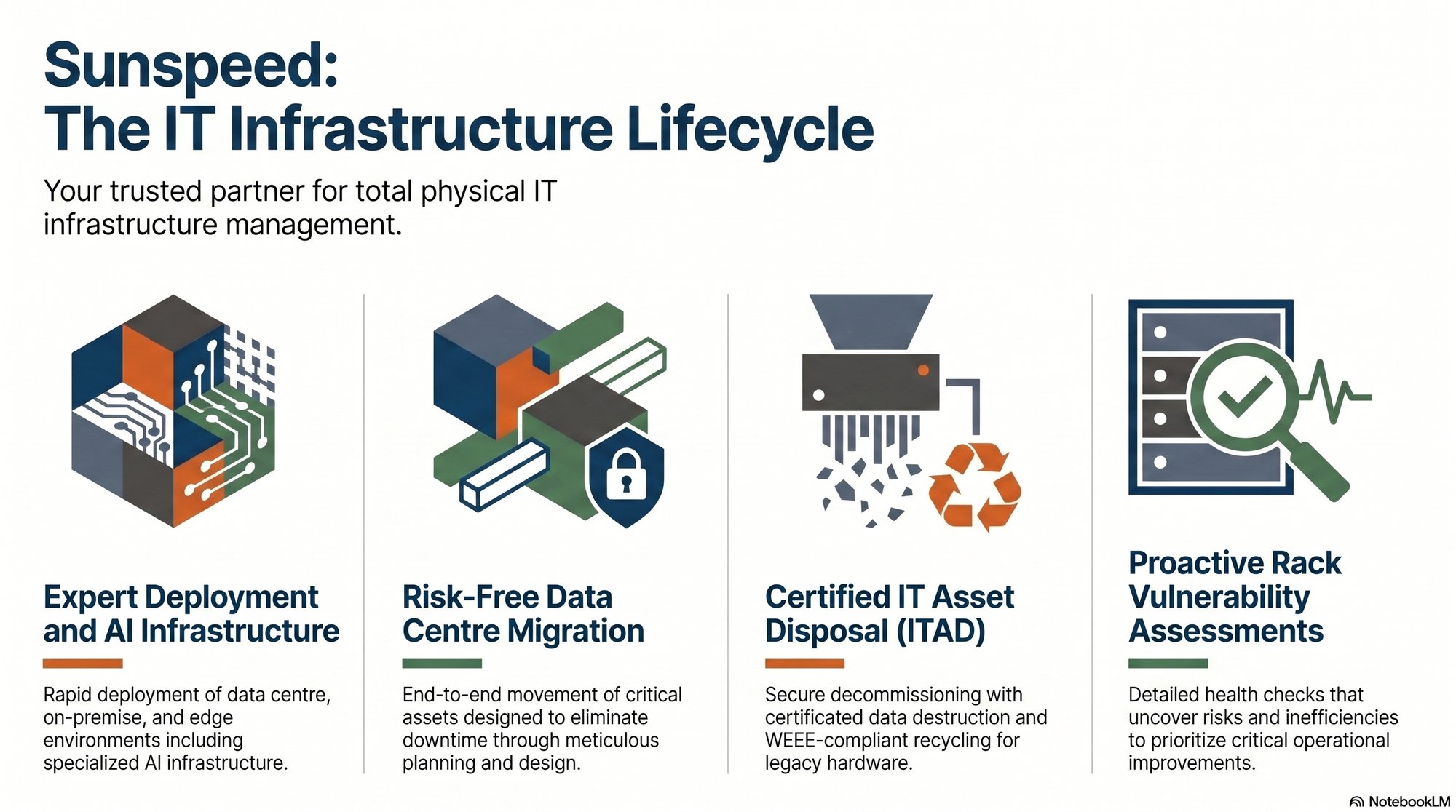
Data centre migration built around your wider strategy
No two data centre migrations are the same.
For some organisations, the goal is a straightforward relocation from one facility to another. For others, it forms part of a consolidation strategy, reducing the number of sites and simplifying operations. Some projects support a move to colocation. Others are linked to cloud transition, disaster recovery redesign, technical refresh, hardware decommissioning or a wider workplace relocation.
Sunspeed’s service can be delivered as a standalone data centre migration project or integrated into broader data centre services. The company supports the full lifecycle of IT assets and environments, including deployment, optimisation, decommissioning and ongoing operational management.
That lifecycle view matters. A migration is not finished when the final device arrives at the new site. The new environment has to be ready to perform.
Racks need to be installed correctly. Cabling needs to be logical, labelled and maintainable. Power and network connectivity need to support the target design. Legacy equipment may need to be removed, wiped, destroyed, resold or recycled. Documentation needs to reflect the new reality.
Sunspeed helps organisations move from one operating state to another, rather than simply shifting equipment from one building to another.
Secure transport for business-critical infrastructure
Physical security is a crucial part of any data centre migration. Servers, storage arrays, network equipment and backup devices may contain sensitive data, support critical services or represent a significant financial investment.
The way these assets are handled, packed, transported and tracked matters.
Sunspeed has extensive experience in secure data centre and server relocation, with specialist vehicles, dedicated relocation project management and experienced IT engineers. This gives customers a specialist partner for the entire physical migration chain.
Equipment can be de-installed by people who understand live technical environments, packed using appropriate materials, moved securely and reinstalled in line with the agreed plan.
For organisations managing regulated data, sensitive workloads or high-value infrastructure, that chain of custody is not a nice extra. It is part of the risk control.
Decommissioning and data destruction after migration
A data centre migration often leaves behind redundant infrastructure. Some equipment may be reused. Some may have resale value. Some may need secure disposal. Some may hold data and require certified destruction.
Sunspeed’s IT Asset Disposal and Data Centre Decommissioning services support the secure, traceable and environmentally responsible removal of redundant equipment. Services include de-installation, collection, certified data destruction, compliant recycling and resale where appropriate.
This matters because migration projects can create compliance gaps if end-of-life assets are not handled properly. Data-bearing devices should not be left in old racks, stored informally or disposed of without documentation.
Sunspeed provides the process, audit trail and certificates needed to close the loop properly.
For organisations under pressure to modernise responsibly, this also supports sustainability objectives. Equipment with residual value can be assessed for resale, while assets without value can be recycled through appropriate downstream channels.
The Sunspeed difference: control, precision and confidence
The reason organisations choose Sunspeed for data centre migration is simple: the work is too important to leave to chance.
Sunspeed manages the detail. That means auditing assets, documenting dependencies, building migration plans, coordinating stakeholders, preparing the destination environment, managing secure transport, reinstalling equipment and supporting handover.
This depth of experience gives customers confidence that potential risks will be identified early and managed properly. It also gives internal IT teams the practical support they need at a demanding point in the infrastructure lifecycle.
A good migration partner should not add complexity. They should remove it.
Sunspeed acts as an extension of the customer’s IT and data centre operations, bringing structured delivery, specialist engineering resource and reliable project control. For busy internal teams already managing business as usual, security demands, service performance and stakeholder expectations, that support can make the difference between a stressful migration and a controlled one.
When should you start planning a data centre migration?
The earlier, the better.
A rushed data centre migration increases the chance of missed dependencies, unclear scope, limited testing and poor communication. Ideally, planning should begin as soon as the business knows that a move, consolidation or exit is likely.
This allows time for audits, site surveys, destination readiness checks, risk workshops, cabling design, stakeholder mapping and runbook development.
Early engagement also helps identify whether the destination environment is genuinely ready. Power, space, cooling, containment, rack layouts, network routes, security access, delivery procedures and cabling pathways all need to be checked before migration weekend arrives.
Sunspeed can support this preparation through discovery, operational readiness assessment and wider data centre services. This can include reviewing room capability, rack installation, power deployment, cabling suitability, capacity usage, security, installation standards, health and safety, change processes and reporting.
That preparation reduces uncertainty and gives the project team more time to fix issues before they become delays.
Data centre migration for colocation, cloud transition and consolidation
Many modern data centre migration projects form part of a hybrid IT strategy. Organisations may be reducing on-premise infrastructure, moving selected workloads to cloud, shifting critical systems into colocation, or consolidating multiple environments into fewer, better-managed sites.
In these scenarios, the physical migration still matters.
Cloud transition does not automatically remove the need to relocate, decommission or reconfigure infrastructure. In fact, hybrid change can make the dependency picture more complicated, because some systems remain physical while others move to virtual or cloud-based platforms.
Sunspeed’s experience across relocation, deployment, cabling, decommissioning and operational management makes it well placed to support these mixed environments.
The company can help organisations rationalise what should move, what should be retired, what should be reinstalled, and what needs to be documented for future support.
That is especially valuable where a data centre migration is being used as an opportunity to improve the environment, not merely reproduce old problems in a new location.
Common data centre migration challenges
Every migration has its own technical and operational challenges, but several issues surface again and again.
One of the most common is poor documentation. Many organisations discover that asset records, cable maps and rack layouts are out of date. Equipment may have been added, moved or changed over time without the documentation keeping pace. During a migration, those gaps can create serious delays.
Another challenge is dependency management. Applications, databases, storage platforms, network devices and security tools are often more interconnected than they first appear. A system that seems simple to move may rely on another service, link or device elsewhere in the environment.
Change windows can also be tight. Many migrations need to happen overnight, over a weekend or during a limited maintenance period. This leaves very little room for confusion, delays or rework.
Sunspeed helps address these challenges through careful planning, practical technical experience and a structured delivery model. By creating accurate documentation, agreeing the sequence and managing the physical process properly, Sunspeed helps reduce avoidable risk.
Frequently asked questions about data centre migration
What is data centre migration?
Data centre migration is the planned movement of IT infrastructure, systems or workloads from one data centre environment to another. In a physical migration, this can include servers, storage, network equipment, racks, cabling and supporting hardware.
It may also involve decommissioning old infrastructure, installing equipment in a new site and validating that services are restored correctly.
Why is data centre migration risky?
Data centre migration is risky because it involves critical systems, technical dependencies, live services, security requirements and strict time windows.
Poor planning can lead to downtime, data loss, damaged hardware, misconfigured cabling, missed dependencies and delays. A specialist partner reduces risk by controlling the audit, planning, logistics, installation and handover process.
How does Sunspeed support data centre migration?
Sunspeed provides end-to-end data centre migration support, including audit and planning, cable mapping, rack elevations, migration runbooks, de-racking, specialist packing, secure transport, installation, cable dressing, power-up support and post-move handover.
Can Sunspeed support data centre decommissioning after a migration?
Yes. Sunspeed supports data centre decommissioning, IT asset disposal, certified data destruction, compliant recycling and resale where appropriate. This helps organisations close down legacy environments securely and responsibly.
Is data centre migration only for large enterprises?
No. Sunspeed supports organisations of different sizes across public and private sectors. A migration might involve a small number of racks, a specialist technical environment, a comms room, a full data centre exit or a multi-site infrastructure programme.
Move with confidence
A successful data centre migration is not measured by whether equipment reaches the destination. It is measured by whether the business remains protected, services are restored as planned, risks are controlled and the new environment is ready for the next stage of the organisation’s strategy.
Sunspeed brings the planning, engineering expertise, secure logistics and project governance needed to deliver that outcome.
For organisations preparing to relocate, consolidate, exit, refresh or modernise their infrastructure, Sunspeed provides the specialist support needed to move critical IT with confidence.
Contact our experts today to discuss Sunspeed.