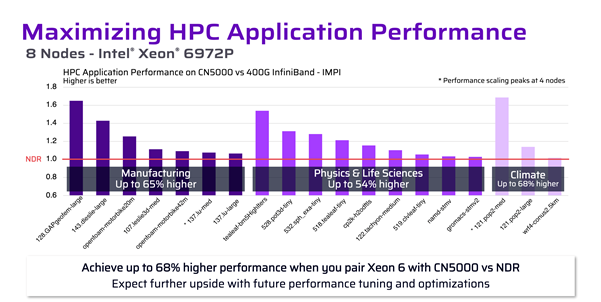
Europe’s physics and life sciences communities are pushing into a new era of extreme-scale computing: exascale-class systems, trillion-parameter AI, data-hungry instruments, and workflows that mix simulation, analytics, and AI in the same job. Here’s the hard truth most people only admit after a brutal first scale test: the network is the bottleneck, not the GPUs, not storage, not even the CPU.
That’s where Cornelis CN5000 Omni-Path® and Hammer’s HPC solution design and delivery fit together: a fabric engineered to stay predictable under heavy load, paired with an approach that helps European organisations design, validate, deploy, and support the architecture that matches their applications.
What’s changed in European research computing and why the fabric matters more than ever
Physics and life sciences are both hitting similar pressure points:
- Large-scale MPI collectives (allreduce/alltoall), sensitive to tail latency
- Many small messages where message rate matters as much as bandwidth
- Incast and bursty traffic (common in AI training, reconstruction, and analytics shuffles)
- Synchronisation-heavy simulation where jitter turns into wasted compute time
When an interconnect congests or introduces long-tail delays, you see utilisation collapses - expensive accelerators sitting idle, waiting for the next batch or collective to complete.
CN5000 in plain terms: what it is, and what it’s designed to fix
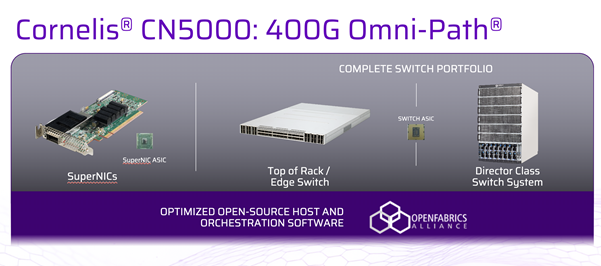
Cornelis CN5000 Omni-Path is a scale-out network platform aimed at AI and HPC environments where you want high throughput and stable performance are required, even when the system is busy.
A few practical points that matter to HPC teams:
- 400G per port switching (CN5000 switches are commonly referenced as 48-port 400G-class, delivering very high aggregate bandwidth per switch)
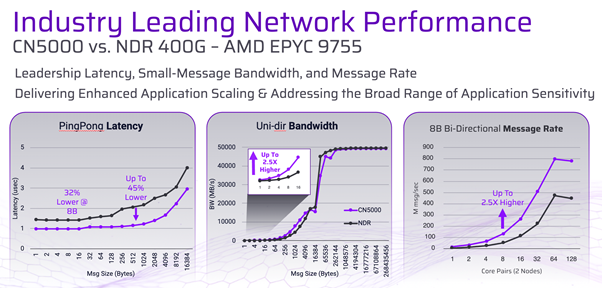
- Very high packet processing capability (critical for small-message HPC traffic)
- A design focus on avoiding performance cliffs through lossless behaviour, fabric congestion management, multipath routing, and robust flow control
The core idea: keep communication predictable when the cluster is full of real jobs, not just when running idealised tests on a quiet fabric.
Where Hammer fits turning CN5000 capability into a deployable European solution
CN5000 is the fabric technology. Hammer’s value is making it work in the real world - balancing performance goals with procurement constraints, timelines, site standards, and operational readiness.
In practice, that usually means:
- Translating application needs (MPI, AI training, pipeline analytics) into a scalable fabric design
- -Validating performance with the right tests (not just vendor-default benchmarks
- Delivering an integrated solution:
- Switching
- Cabling
- Host connectivity
- Configuration
- Rollout support
- Helping teams operationalise:
- Monitoring
- Change control
- Spares strategy
- Day-two support patterns
Comparison table: CN5000 vs common HPC/AI interconnect approaches
The “best” interconnect depends on workload, scale, and operational preferences. The table below is a practical, architecture-level comparison you can use in early-stage design discussions.
|
Criterion |
Cornelis CN5000 Omni-Path |
InfiniBand (modern generations) |
Ethernet (RoCE / high-performance Ethernet) |
|
Primary design target |
AI + HPC scale-out with predictable completion times under load |
HPC/AI scale-out, widely adopted in top-end HPC |
Broad data centre + AI/HPC where standards alignment and common tooling are key |
|
Behaviour under congestion |
Built to minimise congestion impact and keep performance stable (lossless fabric intent) |
Strong options depending on configuration and congestion control |
Can be excellent, but tends to be more sensitive to correct tuning (PFC/ECN, buffering, QoS) |
|
Tail latency sensitivity |
Generally optimised for low latency and message rate |
Generally, very strong for low latency and collectives |
Can be competitive, but tail latency can degrade if misconfigured or oversubscribed |
|
Operational complexity |
HPC-focused tooling and model; typically, more “fabric-first” |
Mature ecosystem; strong operational patterns in HPC |
Familiar to network teams, but “HPC-grade RoCE” usually demands careful design discipline |
|
Ecosystem and integration |
Built for HPC/AI stacks; integration depends on platform choices |
Very broad HPC ecosystem support |
Broadest vendor/tooling ecosystem overall |
|
Typical sweet spot |
Tight collectives, message-rate-heavy HPC, mixed AI/HPC clusters where predictability is the priority |
Very large HPC/AI deployments with established IB practices |
Sites standardising on Ethernet, mixed workloads, or seeking a unified network operational model |
|
Common risk if chosen poorly |
Under-scoping validation (not testing real workload patterns early) |
Cost/availability planning; design choices matter at scale |
“It’s Ethernet, it’ll be fine” thinking, until PFC storms, QoS gaps, or noisy neighbours appear |
If you want a blunt rule of thumb: HPC and scientific AI don’t just need fast links; they need a fabric that stays sane when everyone is communicating at once.
A practical blueprint: deploying CN5000 for European physics and life sciences
1) Start with the communication profile (not port counts)
Ask questions like:
- Are we collective-dominated (allreduce/alltoall)?
- Are we message-rate bound (lots of small messages)?
- Do we see performance cliffs when the system is busy?
- Are GPUs waiting on synchronisation?
This determines whether you should optimise for bandwidth, latency, tail behaviour, or a balanced approach.
2) Design for scaling stages, not a single snapshot
Many European organisations scale in phases:
- Pod or rack-scale proof of value
- Multi-rack production
- Multi-cluster or federated growth
A CN5000 fabric design should reflect that from day one, including topology, cabling strategy, growth ports, and operational boundaries.
3) Validate with Real Science Don’t stop at microbenchmarks. Include:
- MPI collectives at intended scale
- Mini-apps and representative kernels
- AI training comms tests (collective-heavy steps)
- Mixed-tenant stress tests if you run shared infrastructure
The goal is to spot “quiet lab wins” versus “production reality wins” early, while changes are still inexpensive.4) Operationalise early (because day-2 is where projects succeed or die)
Plan for:
- Telemetry and dashboards (latency, congestion signals, link errors, hotspots)
- Change management (firmware, configuration drift, controlled rollout)
- Spares and resilience planning
This is where Hammer’s delivery and support approach can close the gap between a fast fabric and a manageable service.
Reference architecture patterns for European labs and research institutes
Here are three common patterns that work well when building around CN5000 for physics and life sciences environments
Pattern A: “Science pod” for Rapid Adoption
- 1–2 racks of compute (CPU or GPU)
- Dedicated CN5000 leaf switching
- Clear ingress/egress boundaries to storage and the wider campus network
- Ideal for proving real workload gains and training operations teams
Pattern B: Mixed AI + HPC Production Cluster
- Separate logical partitions or queues for:
- AI training
- Simulation
- Data pipelines
- Fabric designed to avoid noisy-neighbour impacts during peak training runs
- Emphasis on predictable collectives and stable job completion times
Pattern C: Multi-cluster growth with shared services
- Multiple CN5000-backed clusters (e.g., life sciences imaging, physics simulation)
- Shared services:
- Authentication
- Scheduling policy
- Monitoring
- Storage
- Fabric strategy focuses on repeatability: “We can deploy this again with confidence.”
There is no single “correct” design-- it’s that you can align the topology and operational model to how your organisation actually works.
Data governance, security, and collaboration across Europe
Physics and life sciences often sit at opposite ends of the data-governance spectrum – from relatively open experimental data in some physics domains, to highly sensitive human data in parts of life sciences. Modern HPC network design must acknowledge that reality.
When deploying CN5000-based infrastructure in European environments, it is essential to build in
- Segmentation by design (projects, tenants, regulated datasets)
- Auditable change control (who changed what, when, and why)
- Clear boundaries to storage and external networks (minimise surprise data paths)
- Collaboration readiness (support for federated access models, where appropriate
None of this is flashy, but it’s often the difference between “a fast cluster” and “a platform the organisation can trust for the next five years”.
Common use cases where CN5000 + Hammer delivery can move the needle
AI training for scientific models
- Collectives, synchronisation points, and burst patterns dominate
- Predictability under load is what improves time-to-results
Large-scale simulation with synchronisation points
- Tail latency and jitter can severely impact tightly coupled physics simulation
- Message-rate capability and stable behaviour matter
Imaging, reconstruction, and multi-omics pipelines
- Workflows mix bandwidth-heavy stages and communication-heavy shuffles
- Often run concurrently across multiple teams
FAQ: How CN5000 Omni-Path helps in real HPC + AI clusters
How does Cornelis CN5000 Omni-Path improve HPC and AI performance in real clusters?
In production clusters, throughput often isn’t the limiter, congestion and long-tail latency are. CN5000 is built to keep communication predictable under load, so jobs don’t hit “performance cliffs” when many tenants or many ranks communicate at once.
Practically, that comes from an Omni-Path design that emphasizes:
- Lossless behaviour with credit-based flow control (so you don’t fall into loss/retransmit spirals under pressure).
- Fine-grained adaptive routing / multipath to steer around transient hotspots.
- Active congestion management (often described as switch-informed pacing/slowdown) to reduce tail effects.
The net effect: fewer stalls in collectives and synchronization phases, and better accelerator utilization when the fabric is busy.
What kinds of workloads benefit most from CN5000 in physics and life sciences?
CN5000 tends to show up best when jitter and tail latency dominate outcomes, especially:
- Tight MPI collectives (e.g., allreduce/alltoall) at scale
- High message-rate applications with many small messages
- Synchronization-heavy simulations where a few slow ranks drag the timestep
- Bursty or incast-heavy traffic seen in multi-node AI training, reconstruction pipelines, and shuffle-heavy analytics
If your profiling increasing time spent in collectives, barriers, or halo exchanges as you scale out, this is the class of problem CN5000 is designed to address.
Why does the network become the bottleneck before GPUs or storage at scale?
As clusters scale, more wall time is spent coordinating (gradients, reductions, exchanges, barriers. When congestion or long-tail delays appear, the fastest nodes and GPUs end up waiting for the slowest communication events. Utilization can collapse even if “peak bandwidth” looks strong paper.
What does “Lossless” Mean in Practice In practice, “lossless” is about avoiding packet loss and retransmission amplify congestion, create latency spikes. These spikes surface as slow collectives and unpredictable job completion times.
CN5000 is positioned around lossless, congestion-free transmission using credit-based flow control and adaptive routing to maintain stability under mixed load.
How is CN5000 different from InfiniBand or high-performance Ethernet (RoCE)?
At a high level:
- CN5000 (Omni-Path): Positioned as an end-to-end scale-out fabric tuned for predictable performance under load, leveraging lossless behaviour, adaptive routing, and congestion control as first-class design goals.
- InfiniBand: widely deployed in top-end HPC with a deep ecosystem and mature operational practices (excellent performance, broad vendor support).
- RoCE / high-performance Ethernet: Operationally familiar and capable of strong performance but typically requires discipline around PFC/ECN design, buffering, QoS, and noisy-neighbour control to avoid tail-latency surprises at scale.
Also worth stating plainly: CN5000’s “full benefits” are typically described as coming from an end-to-end Omni-Path solution (Switches + NICs) rather than mixing-and-matching in the data path.
What does Hammer actually deliver in a CN5000-based HPC project?
Hammer turns the interconnect into something you can run day to day, typically covering:
- Requirements → fabric design: (topology, oversubscription targets, growth plan, cabling strategy)
- Validation: test plans that reflect real workloads (not just quiet-lab microbenchmarks)
- Build and rollout: switches, optics/cables, host connectivity, configuration templates, cutover support
- Operations: monitoring/telemetry expectations, change control, spares strategy, and support runbooks
How should we validate a CN5000 fabric before committing to full rollout?
A practical pre-rollout validation usually includes:
- MPI collective tests at intended scale (not just single-rack)
- Mini-apps / representative kernels from your actual user base
- AI communication tests that stress collective-heavy steps (and overlap patterns)
- Mixed-tenant stress tests to surface noisy-neighbour effects and long-tail behaviour
The goal: catch cases where “quiet lab wins” don’t translate to production—while topology and policy changes are still cheap.
How do we design a CN5000 network for phased growth across European research sites?
Many programs scale in phases (pod → multi-rack → multi-cluster/federation). Common design moves that keep growth painless:
- Pick a topology with a clear expansion path (ports reserved for growth, predictable cabling)
- Define operational boundaries early (tenants/partitions/queues, QoS expectations)
- Plan how you’ll handle change control and “blast radius” when adding racks or sites
That way, scaling doesn’t accidentally introduce new hotspots or noisy-neighbour behaviour
How can CN5000 deployments support data governance and security across Europe?
In regulated life-science environments, the network is part of the control plane for governance. Typical patterns include:
- Segmentation by project/tenant (so regulated datasets don’t share surprise paths)
- Auditable configuration + change control aligned to your security model
- Clear boundaries to storage and external networks to avoid accidental data egress routes
- Where collaboration is needed, deliberate federated access patterns rather than ad-hoc peering
Key takeaways for European research leaders
- The network is increasingly the deciding factor for real performance in physics and life sciences, especially with mixed AI + HPC workloads.
- Cornelis CN5000 targets predictable performance at scale, where congestion behaviour and tail latency often dominate job completion time.
- Hammer helps translate that capability into a working European solution:
- Designed
- Validated
- Deployed
Operable as a service– not just a collection of high-performance components Contact our experts today to discuss Cornelis Networks Solutions
Want to find out more?